

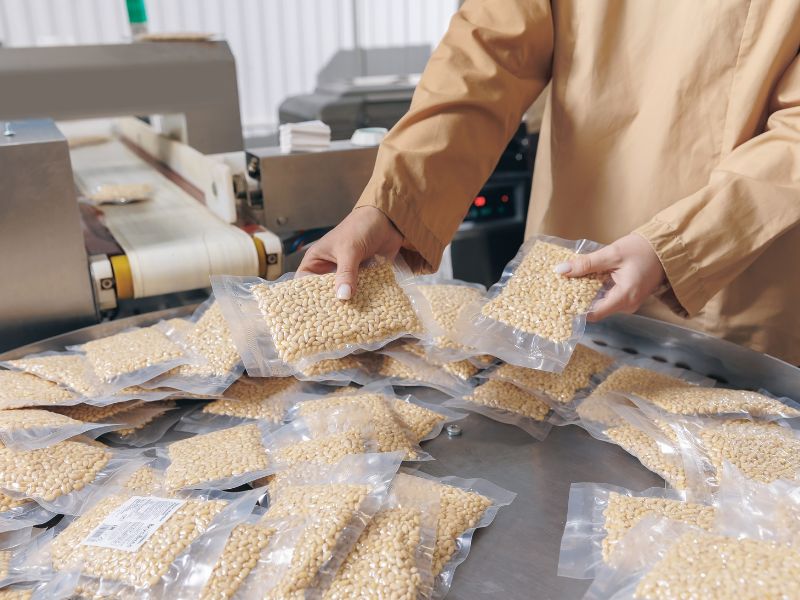
Brands often explore outsourced packaging when internal production lines become overloaded or when growth outpaces current capacity. Outsourcing packaging offers speed, flexibility, and cost advantages, but in-house production still appeals to teams wanting full control. The right choice depends on growth stage, cost structure, operational maturity, and long-term business goals.
This guide compares both models, identifies pros and cons, and outlines the break-even points brands should consider before committing to either path.
What Is Outsourced Packaging
Outsourced packaging refers to working with a contract packaging partner who provides equipment, operators, QA systems, and production capacity. Brands send product or raw materials to the partner, who manages filling, sealing, labeling, and packaging in various formats.
Common services include:
- Powder, liquid, paste, or granule filling
- Pouch, stick pack, sachet, bottle, or jar packaging
- Clean room production
- Retail-ready assembly
- Bulk packaging
- Fulfillment or distribution support
Outsourcing packaging is designed to scale quickly without requiring brands to invest in equipment or internal staff.
What Is In-House Packaging
In-house production means the brand owns equipment, hires operators, manages QA processes, and oversees the entire packaging workflow internally. This model offers high control but comes with significant operational complexity.
In-house production typically involves:
- Purchasing packaging lines
- Training operators and maintenance teams
- Managing QA systems
- Handling warehouse and utilities
- Maintaining equipment uptime
- Managing changeovers and scheduling
In-house production works best for brands with predictable volume and long-term stability.
Outsourced Packaging: Pros and Cons
Understanding the strengths and limitations of outsourcing helps leaders make informed decisions.
Pros of Outsourced Packaging
1. No Equipment Investment
Avoid capital purchases that can cost thousands or millions.
2. Faster Scalability
Ramp up production quickly during spikes, launches, or retail promotions.
3. Reduced Labor Burden
No need to hire, train, or manage production teams.
4. Strong QA Systems Built In
Quality checks, documentation, and compliance come standard with contract packaging partners.
5. Lower Overhead
Utilities, maintenance, repairs, and facility needs shift to the partner.
6. Access to Multiple Packaging Formats
Easily test new SKUs without new machinery.
Cons of Outsourced Packaging
1. Less Direct Operational Control
Production schedules rely on partner availability.
2. Minimum Order Quantities (MOQs)
Some partners require minimum volumes.
3. Coordination Requirements
More communication is needed to ensure alignment.
For most growing brands, these limitations are manageable compared to the cost savings and speed provided by outsourcing packaging.
In-House Production: Pros and Cons
Pros of In-House Production
1. Full Control
You schedule production, monitor operations, and run the line your way.
2. Potential Long-Term Cost Efficiency
High-volume, predictable demand may justify investment.
3. Faster Last-Minute Adjustments
Quick tweaks can be made without external coordination.
Cons of In-House Production
1. High Capital Investment
Packaging lines, building space, electrical upgrades, and HVAC create major expense.
2. Staffing and Training Requirements
Skilled operators and maintenance techs are difficult and costly to retain.
3. Slower Scalability
Adding capacity requires months of planning and large investment.
4. Greater Operational Risk
Breakdowns, shortages, and QA failures fall entirely on your team.
5. Limited Flexibility
Rigid equipment restricts packaging formats and SKU variety.
Break-Even Points: When Each Model Makes Sense
Knowing when outsourcing packaging or in-house production makes financial sense helps avoid costly mistakes.
Outsourced Packaging Makes Sense When:
- You are launching new SKUs
- Demand is growing quickly
- You need flexible batch sizes
- You have seasonal or unpredictable volume
- You cannot invest in equipment yet
- Your team is overloaded with production
- You need retail-ready packaging fast
Most startup and mid-market CPG brands fit this profile.
In-House Production Makes Sense When:
- You have stable, high-volume demand
- Your production volume is predictable
- You run limited packaging formats
- Equipment investment will pay off within a defined timeframe
- You can support maintenance, QA, and labor internally
Established brands with consistent long-term volume benefit most from in-house production.
Hybrid Models: The Best of Both Worlds
Many brands use a blended approach:
- In-house for core SKUs
- Outsourced packaging for new products
- Co-manufacturing for overflow
- Seasonal spikes handled externally
- Pilot runs done externally before scaling internally
This model reduces risk and supports flexibility.
How MaxUS Helps Brands Scale Through Outsourced Packaging
MaxUS provides outsourced contract packaging services that help brands grow faster and more efficiently. Our systems are built to support high volume packaging, multi-format runs, and fast changeovers.
We deliver:
- Filling for powders, liquids, pastes, and granules
- Stick pack, pouch, bottle, jar, sachet, and bulk packaging
- Clean room production for sensitive SKUs
- Blending and mixing support
- Automated sealing, labeling, and coding
- Case packing, palletizing, and fulfillment
- Flexible capacity for overflow or ongoing volume
Our goal is to help brands scale without taking on new equipment, labor, or overhead.
Key Takeaways
- Outsourced packaging offers speed, flexibility, and lower overhead.
- In-house production provides control but carries high operational cost.
- Break-even points depend on demand stability, SKU variety, and capital budget.
- Hybrid models allow brands to adapt as needs change.
- MaxUS provides flexible outsourced packaging solutions for brands at every stage.
If you are deciding whether to outsource packaging or produce it in-house, MaxUS can help. Our flexible capacity, multi-format packaging, and strong QA systems support growth without added overhead.Connect with our team to explore the best model for your next stage of growth.