


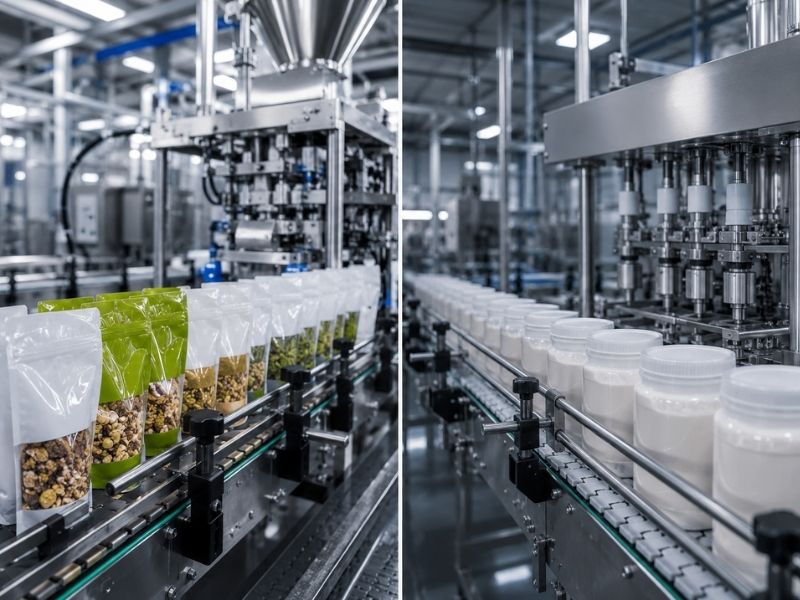
Rigid packaging is often the default for many products, but it is not always the best fit. Choosing between rigid and flexible formats is one of the most important decisions in consumer good packaging, especially as brands scale and product demands evolve.
The right choice impacts cost, shelf presence, production efficiency, and long-term scalability. The wrong choice creates friction across your entire operation.
Understanding the Difference Between Packaging Types
Before making a decision, it is important to understand how these formats differ.
Rigid packaging includes:
- Bottles
- Jars
- Tubs
- Canisters
These formats maintain their shape and offer durability and structure.
Flexible packaging includes:
- Pouches
- Sachets
- Stick packs
- Bags
These formats are lightweight, adaptable, and designed for efficiency.
Each serves a different purpose depending on your product and operational goals.
When Rigid Packaging Is the Better Choice
Rigid packaging is often the right fit when structure and protection are critical.
It works best for:
- Products that require durability during transport
- Items that benefit from a premium or sturdy shelf presence
- Liquids or materials that need stable containment
- Products with longer shelf life requirements
Rigid packaging also provides consistency in handling and storage, which can simplify certain production processes.
Where Flexible Packaging Has the Advantage
Flexible formats offer efficiency and adaptability, especially as brands scale.
Advantages include:
- Lower material and shipping costs
- Reduced storage space requirements
- Faster production setup and changeovers
- Greater flexibility for different product sizes
For many consumer good packaging applications, flexible packaging supports speed and cost efficiency without sacrificing quality.
Cost Considerations: More Than Material Price
Cost is often a deciding factor, but it is not just about packaging materials.
Rigid packaging typically involves:
- Higher material costs
- Increased shipping expenses due to weight and space
- More storage requirements
Flexible packaging often reduces:
- Material usage
- Transportation costs
- Warehousing needs
However, the total cost depends on your production volume, distribution model, and operational efficiency.
How Packaging Impacts Production Efficiency
Your packaging choice directly affects how efficiently your operation runs.
Rigid packaging may require:
- More complex filling systems
- Longer setup times
- Greater handling requirements
Flexible packaging can:
- Streamline production processes
- Reduce changeover time between SKUs
- Support faster scaling
For operations focused on speed and adaptability, flexible formats often provide an advantage.
Shelf Presence and Brand Perception
Packaging plays a major role in how your product is perceived.
Rigid packaging is often associated with:
- Premium positioning
- Durability
- Reusability
Flexible packaging is often used for:
- Convenience
- Portability
- Cost-conscious products
The right choice depends on how you want your product to be positioned in the market.
Scalability: Planning for Growth
One of the most overlooked factors in consumer good packaging decisions is scalability.
Rigid packaging can become limiting if:
- Storage space is constrained
- Shipping costs increase significantly with volume
- Production systems are not designed for flexibility
Flexible packaging is often easier to scale because it:
- Requires less space
- Supports variable run sizes
- Adapts more easily to changing demand
Choosing the right format early can prevent costly changes later.
How to Make the Right Decision
There is no one-size-fits-all answer.
The right choice depends on:
- Your product type and requirements
- Your target market and brand positioning
- Your production capabilities
- Your growth strategy
Many brands also use a combination of both formats depending on their product lines and distribution channels.
The Role of the Right Partner
Making the right packaging decision is easier with the right guidance.
An experienced partner can help you:
- Evaluate packaging formats based on your product
- Understand cost and operational implications
- Design systems that support both current needs and future growth
- Transition between formats as your business evolves
This ensures your packaging supports your operation, not limits it.
Your Premier Packaging Partner
Rigid packaging and flexible packaging each serve a purpose, but the right choice depends on your product, your market, and your growth plans.
If you are evaluating consumer good packaging options, MaxUS Operations can help you choose and implement a solution that supports both performance and scalability.
FAQ Section
What is rigid packaging used for?
Rigid packaging is used for products that require durability, structure, and strong shelf presence, such as bottles, jars, and tubs.
Is flexible packaging more cost-effective than rigid?
In many cases, yes. Flexible packaging typically reduces material, shipping, and storage costs.
Can brands use both rigid and flexible packaging?
Yes. Many brands use a combination of both depending on the product and distribution strategy.
How do you choose between rigid and flexible packaging?
The decision should be based on product requirements, cost considerations, production efficiency, and long-term scalability.