

For many CPG brands, the biggest challenge isn’t product innovation. It’s getting that product filled, packaged, and into customers’ hands efficiently. As demand grows, internal teams often find themselves pulled between scaling production, managing equipment limitations, and maintaining quality. That’s where contract packaging comes in.
If you’re asking “what is contract packaging?”, think of it as a specialized operational partner that manages all or part of your packaging and fulfillment workflow. From blending and filling to final distribution, contract packaging services give brands the flexibility and production power they need without the overhead of doing it all in-house.
What Is Contract Packaging?
At its core, contract packaging (or “co-packing”) is the outsourcing of packaging, filling, labeling, and related production tasks to a third-party expert. Instead of buying equipment, hiring line operators, and managing compliance yourself, you partner with a team that already has the systems, people, and processes in place.
A contract packager may handle:
- Product filling: liquids, powders, solids, granules, or pastes
- Blending or mixing (when required before filling)
- Flexible and rigid packaging formats
- Coding, labeling, and inspection
- Retail-ready prep and assembly
- Bulk packaging for B2B customers
- Warehousing, storage, and fulfillment
Some co-packers offer only packaging.
MaxUS provides the complete package: product to packaged to shipped.
How Contract Packaging Works: Step-by-Step
While every brand’s needs look a little different, most contract packaging workflows follow a similar structure. Here’s how a product moves from intake to finished goods.
1. Understanding Requirements and Product Intake
The first stage is a deep dive into your needs. This is when the partner learns about your formula, packaging type, volume, run frequency, quality expectations, and compliance requirements.
But it’s also where the foundation of the relationship is built. At MaxUS, this phase is handled collaboratively; engineering, operations, and quality teams come together to design the right solution around your product.
2. Packaging Selection & Material Sourcing
Once specs are defined, the packaging format comes into focus.
Brands may choose:
- Flexible packaging like stand-up pouches, stick packs, or sachets
- Rigid packaging such as bottles, jars, tubs, or canisters
- Bulk formats for industrial or B2B applications
Your co-packer may source these materials or work with the packaging you provide. The goal is to balance performance, protection, cost, and brand presentation, all while ensuring packaging runs smoothly on the line.
3. Blending, Mixing, or Product Preparation (If Needed)
Not all products arrive ready to package. When formulation support is needed, the co-packer handles tasks such as:
- Powder blending
- Powder/liquid integration
- Homogeneous mixing
- Viscosity adjustments
- Pre-filling QA checks
This step is especially common with supplements, food products, beverages, and personal care formulations.
4. Filling and Packaging on the Production Line
This is the part most people imagine when they hear “co-packing.”
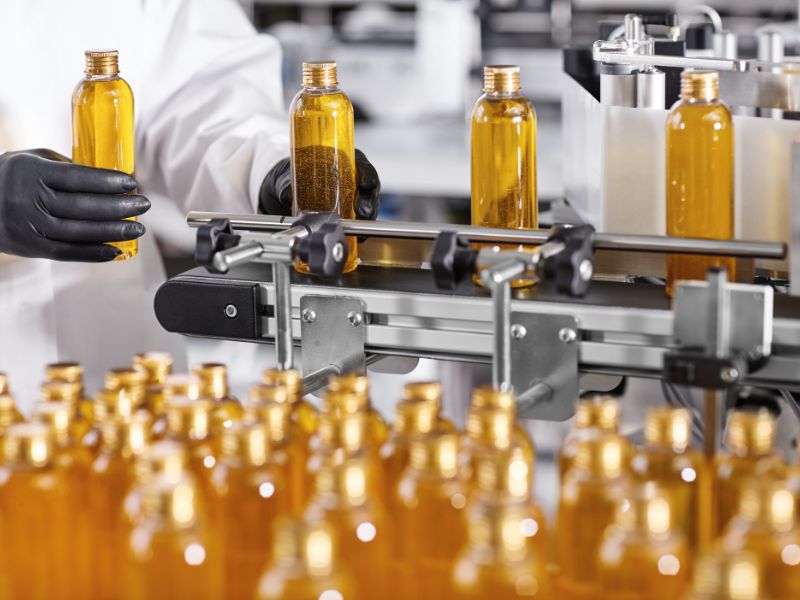
Products enter automated or semi-automated equipment designed specifically for your format. Depending on the packaging method, the line may involve:
- Pouch or sachet filling
- Stick pack formation and sealing
- Bottle or jar filling
- Capping and induction sealing
- Coding, labeling, and inspection
Consistency matters here. A reliable contract packager ensures accurate fills, tight tolerances, and scalable production without compromising quality.
5. Quality Assurance and Compliance
No contract packaging service is complete without rigorous QA.
Depending on your industry, this may include:
- Metal detection
- Checkweighing
- Label verification
- Retained samples
- Lot codes and traceability
- FDA or GMP compliance requirements
- Documentation to support audits or retailer requirements
In food, beverage, supplement, and health products, quality is non-negotiable, and your co-packer should feel like a safety net, not a risk.
6. Final Packing, Storage, and Fulfillment
Once packaging is complete, finished goods are prepared for distribution. This often includes case packing, palletization, shrink-wrapping, or direct-to-retail prep.
Full-service partners like MaxUS extend support even further by offering fulfillment, warehousing, and distribution, reducing the number of vendors involved and keeping your process tightly streamlined.
Why Brands Use Contract Packaging Services
While cost savings are often the entry point, the strategic reasons run much deeper.
Brands turn to contract packaging for:
Speed to market
Quicker setup and faster production runs allow you to respond to market opportunities without delay.
No capital expenditure
Avoid multimillion-dollar equipment investments, especially helpful for startups, seasonal brands, or companies expanding into new categories.
Scalability
Increase production during peak seasons without hiring or expanding internal lines.
Access to specialized expertise
Stick pack lines. Clean rooms. Automated pouching. High-accuracy fillers.
Most brands don’t have this equipment in-house.
Operational consistency
Experienced line operators + proven processes = higher accuracy and fewer mistakes.
Reduced risk
Your operations stay resilient even when internal staffing, logistics, or equipment challenges arise.
When done well, contract packaging doesn’t just “add capacity.” It strengthens your operational backbone.
How MaxUS Approaches Contract Packaging
MaxUS was built around flexibility. Whether you’re packaging a new SKU or scaling a top seller, you get a partner engineered for precision and designed for speed.
Our approach combines:
- Flexible production lines that adapt to your SKU changes
- Experienced operators who care deeply about quality
- Engineering expertise to customize processes
- Clean room environments for sensitive products
- Full-service support from blending to fulfillment
You get reliable throughput, consistent quality, and a team invested in every product that leaves the line.
Key Takeaways
- Contract packaging allows brands to outsource everything from filling to final distribution.
- It supports growth by reducing capital expenses, adding scalability, and improving speed.
- The process includes intake, sourcing, blending, packaging, QA, and fulfillment.
- A partner like MaxUS provides the people, equipment, and responsiveness needed to operate with confidence.
Need a trusted partner to handle your packaging from start to finish?
MaxUS delivers flexible, high-quality contract packaging services designed to help your brand grow with speed and precision.
Let’s build your next operation together.