


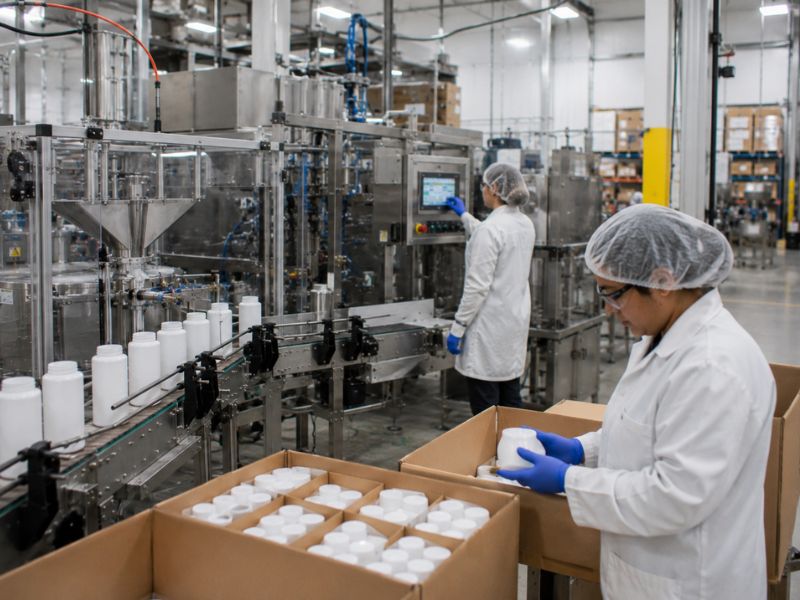
What is contract manufacturing, stripped down to the basics? A partner takes on production steps a brand would otherwise have to build and staff internally — blending, filling, packaging, sometimes fulfillment. The harder question isn’t whether to outsource. It’s which specific functions to hand off first, and which ones a brand should hold onto even as everything else moves out.
What Contract Manufacturing Actually Covers
Contract manufacturing spans a wide range depending on the partner and the agreement. A cpg contract manufacturer might run a single production step under a toll arrangement, or handle the full path from raw ingredients to a finished, packaged product ready for a retail shelf. Scope varies enough between contract manufacturers that two brands describing themselves as “outsourced” can mean very different production setups.
What Most Brands Keep In-House
- Formulation and recipe development, since this is usually a brand’s core intellectual property
- Marketing, branding, and retail relationships, which stay closest to the customer
- Quality standards and specifications, even when a partner executes the actual production
- Final approval on packaging design and label content
What Most Brands Delegate First
Contract manufacturing outsourcing typically starts with the functions that require the most capital to build in-house: equipment-heavy production steps like filling and packaging, warehousing space, and specialized labor for a specific process. These are the areas where owning the infrastructure rarely pays off until volume is large and predictable enough to justify it.
Contract Manufacturing Examples Across Categories
[Suggested image: Split visual showing different CPG categories moving through outsourced production — alt text: “contract manufacturing examples across CPG categories”]
Contract manufacturing examples span food and beverage, personal care, health and wellness, and industrial products alike. A supplement brand outsourcing powder filling, a beverage company using a co-packer for cans, and a cleaning products brand relying on a contract manufacturer for liquid blending are all working the same basic model, adjusted for their specific product and category requirements.
Where the Line Gets Blurry
Some functions don’t fit neatly into either category. Quality control, for instance, often becomes a shared responsibility — the brand sets the standard, but a contracted manufacturing partner executes the day-to-day checks. Sub-assembly and kitting sit similarly in between, sometimes handled in-house for small runs and outsourced once volume grows past what internal staff can manage.
How Ownership Shifts as a Relationship Matures
The keep-versus-delegate line rarely stays fixed once a contract manufacturing relationship gets underway. A brand that started by outsourcing only filling often ends up handing over packaging design coordination too, once the manufacturer has proven reliable on the simpler step. That shift usually happens gradually, and it’s worth revisiting the split periodically instead of treating the original agreement as permanent.
Building the Relationship to Support That Shift
A contract manufacturer worth expanding responsibility with generally earns that trust through consistent communication and predictable execution on the first function handed over, not through a sales pitch about broader capability. Brands that track a partner’s actual reliability on an initial small scope have a much better basis for deciding what to delegate next than brands that hand off multiple functions all at once based on a proposal alone.
FAQs
What is contract manufacturing in simple terms?
A contract manufacturer produces goods on behalf of a brand, using the brand’s formula or specification, so the brand doesn’t need to own the equipment or facility to bring a product to market.
Do brands need to give up product formulation control to outsource contract manufacturing?
No — formulation ownership generally stays with the brand throughout a standard contract manufacturing relationship; the manufacturer produces to that formula instead of developing or altering it independently.
What functions should a growing CPG brand keep in-house the longest?
Formulation, brand strategy, and customer relationships tend to stay in-house well past the point where production, packaging, and warehousing have already moved to outside partners.
How do I find contract manufacturing examples similar to my product category?
Ask potential partners directly for case studies or references within your specific category — a manufacturer’s general capability list doesn’t always reflect deep experience with your exact product type.
Delegate What Makes Sense, Keep What Matters
MaxUS handles the equipment-heavy side of production — blending, filling, and packaging — so your team can stay focused on formulation and brand. Not sure where to draw that line for your product? Walk through it with us.