


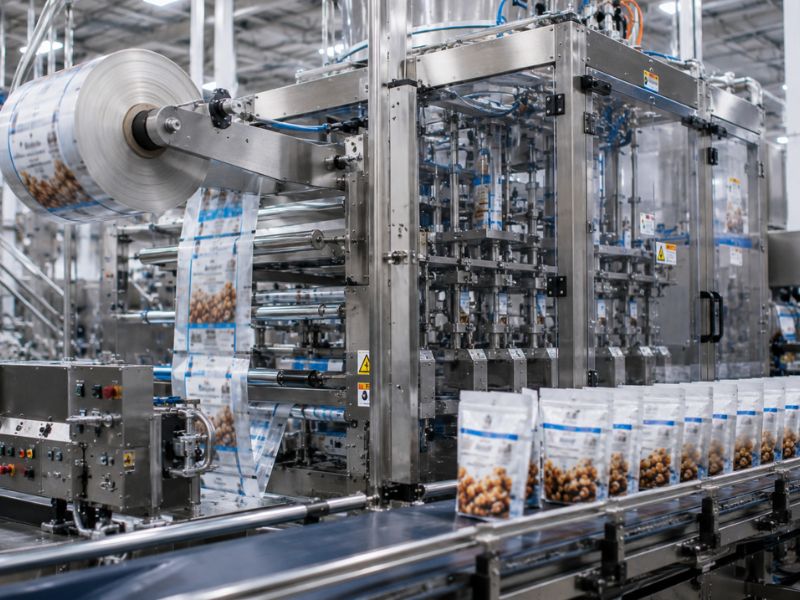
Powders, liquids, and solids each move through a flexible packaging line differently, and a format that works well for one rarely works cleanly for another. Choosing the right flexible packaging solutions before production starts avoids the cost and delay of reformatting a product that’s already running.
Why Product Type Drives Flexible Packaging Format
Powders need dust control and consistent flow through the fill head. Liquids need seal integrity and a fitment that won’t leak under shipping pressure. Solids need enough bag strength and shape to hold their form on a shelf. The format decision starts with the product, not the other way around.
Pouches, Sachets, and Stick Packs for Powders and Solids
Stick packs and sachets suit single-serve powders where portion control matters more than shelf footprint. Stand-up pouches suit solids and blended powders that need shelf presence, a resealable closure, or room for branding beyond a small single-serve format. Pouch packaging in either format depends on getting fill weight and seal consistency right before a run scales past a few thousand units.
Common Mistakes When Choosing a Flexible Format
Format decisions made too early or too late both create problems. A few patterns show up often enough to watch for directly.
- Locking in a pouch size before confirming fill weight tolerances with the actual product
- Choosing a fitment based on appearance rather than compatibility with the product’s viscosity
- Skipping a shipping test before committing to a full production run
- Assuming a format that worked for one product will perform the same way for a reformulated version
Spouted and Fitment Pouches for Liquids
Liquid products bring their own set of format requirements. Flexible packaging fitments — the spouts, caps, and seals attached to a pouch — need to match the product’s viscosity and how the end user will actually dispense it, whether that’s a controlled pour or a quick squeeze.
- Spouted pouches for products dispensed in controlled amounts
- Fitment pouches built for compatibility with pumps or closures added downstream
- Seal strength tested against the product’s viscosity and shipping conditions
- Barrier film selection matched to shelf-life and ingredient sensitivity
Horizontal vs Vertical Form Fill Seal: Which Applies to Your Product
Horizontal form fill seal packaging generally suits pre-formed pouch shapes, fitments, and products that benefit from a flat-bottom or stand-up format. Vertical form fill seal tends to fit high-speed runs of free-flowing powders or granular product, where the pouch forms, fills, and seals in a continuous vertical motion. The right choice depends on your product’s flow characteristics and your target production speed more than personal preference.
[Suggested image: Comparison of horizontal and vertical form fill seal packaging lines — alt text: “flexible packaging solutions form fill seal comparison”]
Matching Format to Retail and Shelf Requirements
Format decisions don’t stop at the production line. What holds up in shipping and what performs on a shelf aren’t always the same thing.
- Stability when the package needs to stand upright on a shelf
- Resealability if the product is used across multiple occasions
- Print surface area available for branding and required label information
- Case-pack efficiency for freight and warehouse storage costs
FAQs
Can the same pouch format work for both a powder and a liquid version of a product?
Sometimes, but the film barrier, seal strength, and fitment usually need adjusting even if the pouch shape stays similar, since liquids and powders stress packaging differently during shipping and shelf life.
What’s the difference between a fitment pouch and a spouted pouch?
A spouted pouch has an integrated spout built for pouring or dispensing. A fitment pouch is designed to accept a separate cap, pump, or closure added during or after filling, which gives more flexibility in how the end product is used.
Is flexible packaging less expensive than rigid packaging at scale?
It often costs less per unit in material and freight, largely due to lighter weight and denser case-pack efficiency, though the right comparison depends on the specific product, format, and production volume.
How do I know if my product needs horizontal or vertical form fill seal?
Free-flowing powders and granular products at high speed tend to run well on vertical form fill seal equipment, while pre-formed shapes and fitment-based pouches usually run better on horizontal lines — a packaging partner can confirm which fits your specific product.
Format Guidance Before You Commit to a Production Run
MaxUS Operations produces flexible packaging across pouches, sachets, stick packs, and fitment formats, supported by filling, blending, and mixing for powders, liquids, and solids. If you’re not sure which format fits your product, get in touch before locking in a production plan.