


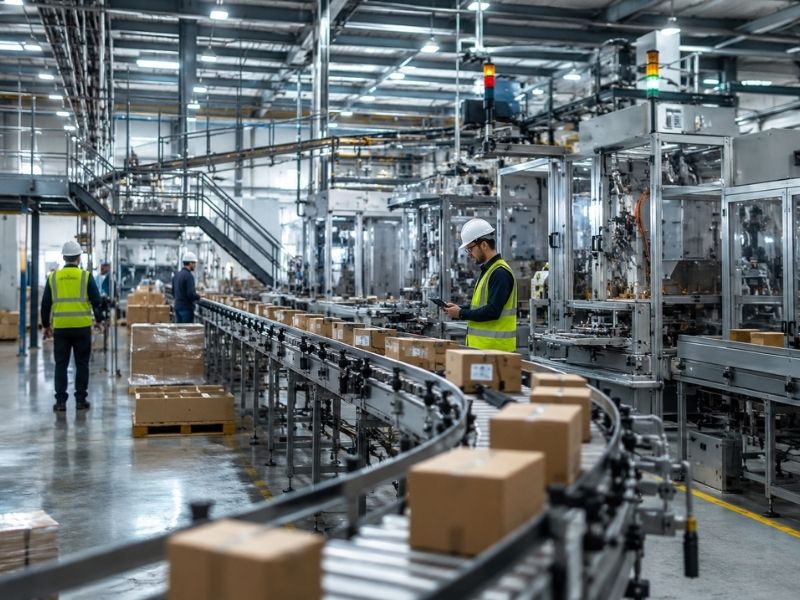
Large scale packaging doesn’t fail all at once. It breaks in predictable places, usually under pressure, when demand increases, timelines tighten, and systems that worked at smaller volumes start to show their limits.
For operations leaders, the challenge isn’t just scaling output. It’s maintaining consistency, speed, and control across increasingly complex packaging operations. Knowing where things break first is the difference between staying ahead of demand and constantly reacting to problems.
The Reality of Scaling Packaging Operations
Scaling isn’t just doing more of the same.
As production increases, packaging operations become more complex:
- More SKUs running simultaneously
- More changeovers between products
- Higher labor coordination requirements
- Greater pressure on equipment and timelines
Without the right systems in place, even small inefficiencies multiply quickly in large scale packaging environments.
What Breaks First: Coordination and Communication
Before equipment fails, coordination usually does.
In growing operations, teams often struggle with:
- Misaligned schedules between production stages
- Gaps between filling, packaging, and labeling teams
- Delays caused by unclear ownership
- Increased reliance on manual communication
When coordination breaks down, timelines slip. And once timelines slip, the rest of the operation starts to follow.
How to Prevent It
- Centralize project ownership under one accountable team
- Standardize communication across departments
- Reduce handoffs between vendors or internal groups
- Implement systems that track progress in real time
What Breaks Next: Line Efficiency
As volume increases, packaging lines are pushed harder. Efficiency becomes harder to maintain.
Common issues include:
- Slower changeovers between SKUs
- Increased downtime between runs
- Bottlenecks at specific points in the line
- Inconsistent output due to variability in setup
These issues don’t always appear at lower volumes, but they become unavoidable in large scale packaging.
How to Prevent It
- Optimize line setup for faster changeovers
- Identify and eliminate bottlenecks early
- Use automation where possible to stabilize output
- Design processes with scalability in mind, not just current needs
Where Quality Starts to Slip
Quality issues rarely start as major failures. They show up as small inconsistencies that grow over time.
In high-volume environments, this can look like:
- Label misalignment
- Seal inconsistencies
- Variation in fill levels
- Packaging defects that increase over longer runs
Without strong controls, these issues compound and create risk, especially in regulated or food-grade environments.
How to Prevent It
- Build quality checks into every stage of the process
- Standardize procedures across teams and shifts
- Use automated systems to reduce variability
- Monitor output continuously, not just at the end of production
Labor Strain and Resource Gaps
As operations scale, labor becomes a critical pressure point.
Challenges often include:
- Difficulty staffing for peak demand
- Increased reliance on overtime
- Training gaps as teams expand quickly
- Reduced efficiency due to fatigue or inconsistency
Labor strain doesn’t just impact productivity. It increases the likelihood of errors across packaging operations.
How to Prevent It
- Plan for scalable staffing models
- Cross-train teams to increase flexibility
- Reduce reliance on manual processes through automation
- Partner with external teams when internal capacity is stretched
The Breaking Point: When Systems Can’t Keep Up
Eventually, the biggest issue becomes structural.
When packaging operations are not designed to scale, teams are forced into reactive mode:
- Constantly adjusting schedules
- Managing delays instead of preventing them
- Making short-term fixes instead of long-term improvements
At this point, operations become harder to control and more expensive to maintain.
How to Stay Ahead in Large Scale Packaging
Preventing breakdowns in large scale packaging requires a shift in mindset.
Instead of asking, “How do we handle more volume?” the question becomes:
“How do we build systems that are designed for growth from the start?”
That means:
- Investing in scalable processes
- Reducing complexity wherever possible
- Centralizing accountability
- Leveraging partners who can absorb fluctuations in demand
For many organizations, this is where external support becomes part of the strategy, not just a temporary fix.
Your Large-Scale Packaging Partner
Large scale packaging doesn’t fail randomly. It fails where systems aren’t built to handle growth.If your packaging operations are starting to feel strained, MaxUS Operations can help you build scalable, flexible systems that keep your production moving without disruption.