


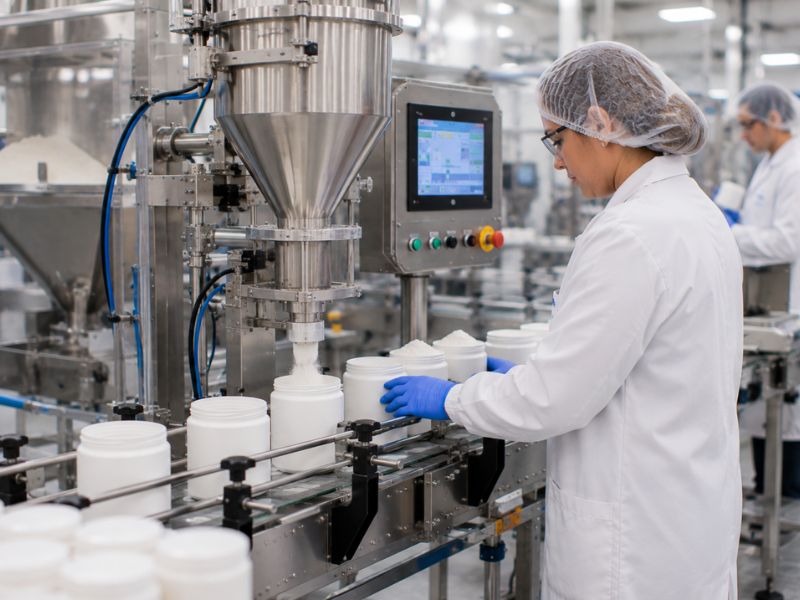
Powder filling introduces problems that liquids and solids simply don’t create on a packaging line. Flow inconsistency, dust, and static all show up as fill accuracy or sealing issues downstream, and a line built without those challenges in mind tends to run slower than its rated speed once real powder starts moving through it.
Flow Inconsistency and Why It Throws Off Every Downstream Step
Powder doesn’t move through a fill head the way a liquid does. Particle size, moisture content, and even the ambient humidity on a given day change how freely a powder flows, and inconsistent flow shows up as variable fill weight before it shows up as anything else. Product filling equipment calibrated for one batch’s flow characteristics can drift out of tolerance when a new batch behaves even slightly differently.
Dust Control and Line Contamination Risk
- Fine powders generate airborne dust that settles on seal surfaces, weakening seal integrity
- Dust buildup inside equipment requires more frequent cleaning cycles than liquid or solid production
- Cross-contact between different powder formulations becomes a real risk without dedicated dust containment
- Automated filling services built for powder specifically include dust extraction that general-purpose lines often lack
Fill Accuracy at Speed
A line running fast enough to hit production targets makes fill accuracy harder to hold for powder than for most other product types. Dosing systems need to compensate for flow variation in real time, not just at the start of a run, since a formulation’s behavior can shift partway through a long production block.
Sealing Problems Powder Creates That Liquids Don’t
A stray grain of powder caught in a seal surface breaks the seal integrity of an otherwise correctly filled package, which is a failure mode liquids rarely produce in the same way. Dry packaging formats need seal inspection tuned specifically to catch this kind of defect, since it’s easy to miss on a standard visual check.
[Suggested image: Powder filling equipment with visible dust containment on a packaging line — alt text: “powder filling dust control on packaging line”]
Throughput Trade-offs Most Brands Don’t Expect
Powder filling generally runs slower than liquid filling at comparable production scale, once dust control, dosing accuracy, and seal inspection are all accounted for. Food blending services upstream of filling can help by delivering a more consistent blend into the fill head to begin with, reducing how much variation the filling stage has to compensate for on its own.
How the Right Partner Solves These Problems
Toll processing services focused on powder handle dust containment, dosing calibration, and seal inspection as a built-in part of the process, not an add-on. Contract filling and packaging partners with dedicated powder experience typically catch these issues before a run starts, not partway through one.
FAQs
Why does powder flow inconsistency matter if the final fill weight is correct?
Even when average fill weight looks correct across a run, inconsistent flow can create individual packages that fall outside acceptable tolerance in either direction, which matters for both compliance and customer experience.
Can automated filling services reduce dust contamination on a powder line?
Yes — automated systems built specifically for powder typically include dust extraction and containment that general-purpose or manually operated lines don’t have built in.
Does powder filling require different sealing than liquid or solid products?
Often, yes. Seal surfaces need protection from stray powder particles, and inspection needs to catch seal defects caused by contamination — a visual check for a complete seal alone tends to miss them.
What throughput should I expect from a powder filling line compared to liquids?
Powder filling generally runs slower once dust control and dosing accuracy are factored in, though the exact gap depends heavily on the specific product’s flow characteristics and particle size.
Powder Handling Built Into the Process
MaxUS runs powder filling with dust control, dosing calibration, and seal inspection built into the line, backed by filling, blending, and mixing upstream. Bring us your powder’s flow characteristics and target volume — start here — and we’ll flag what to plan for before production starts.