


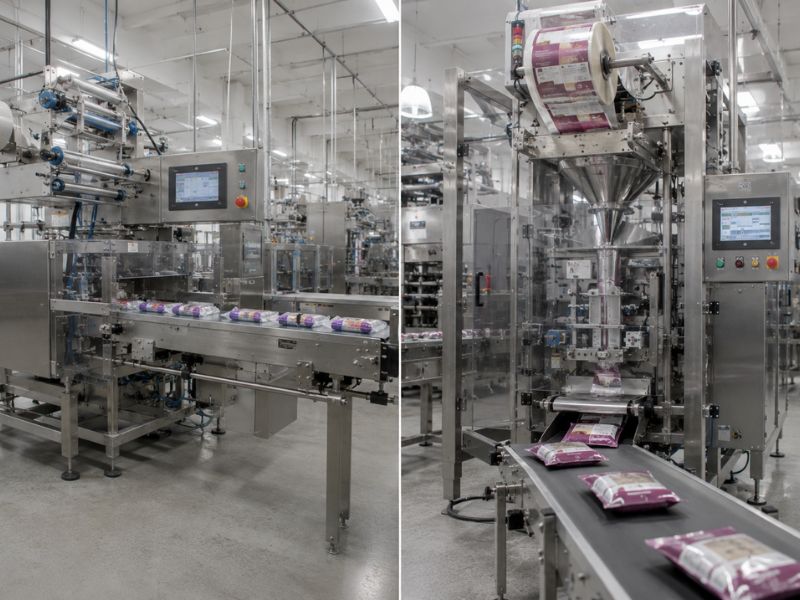
Horizontal form fill seal vs vertical form fill seal: both build, fill, and seal a pouch on a single line, but they solve for different product shapes and production goals. The short answer: horizontal equipment suits pre-formed pouch shapes and products needing a flat-bottom or stand-up format, while vertical equipment suits high-speed runs of free-flowing powders or liquids where raw throughput matters more than pouch styling.
What Horizontal Form Fill Seal Does
Horizontal form fill seal packaging forms a pouch shape — often a stand-up pouch, a flat sachet, or a spouted format — before filling, moving the pouch through the line horizontally as it’s built, filled, and sealed. This process suits products where the finished pouch shape and shelf presentation matter as much as fill speed, which is why it shows up so often on products competing for attention on a crowded retail shelf.
What Vertical Form Fill Seal Does
Vertical form fill seal forms film into a tube, fills it from above as it drops, and seals it in a continuous vertical motion. The process favors free-flowing powders, granules, and some liquids, achieving higher unit-per-minute output than horizontal equipment for products that don’t need a complex pre-formed shape.
Horizontal vs Vertical: Side-by-Side Differences
- Pouch shape: horizontal supports stand-up and spouted formats; vertical typically produces simpler pillow or gusseted bags
- Throughput: vertical usually runs faster for free-flowing products; horizontal trades some speed for shape flexibility
- Product fit: horizontal suits products needing a defined shelf presence; vertical suits high-volume powders and granular fills
- Equipment footprint: the two processes use different machine configurations, so switching between them mid-production isn’t a simple changeover
Product Types That Favor Each Process
Snack foods, powders in stand-up pouches, and products with a fitment or spout tend toward horizontal form fill seal solutions. Cereal, coffee, pet food, and other free-flowing dry products at high volume tend toward vertical form fill seal instead, where the simpler bag shape trades off against faster line speed.
Equipment Setup and Throughput Differences
Both processes fall under broader automated packaging systems, but the equipment itself isn’t interchangeable. A facility offering both horizontal form fill and seal and vertical capability typically runs them as separate dedicated lines rather than a single machine configured to switch between the two, since the mechanical process differs enough to make a shared line impractical.
Making the Call for a New Product
For a product still in development, the decision usually comes down to two questions: does the finished package need a specific shape or standing format, and does the product flow freely enough to run at high vertical speeds? A product answering yes to the first question points toward horizontal equipment, while a product answering yes to the second points toward vertical. Products that don’t clearly favor either question are worth testing on both, since packaging equipment solutions built for one process rarely translate cleanly to the other once a line is already running.
FAQs
Can the same facility run both horizontal and vertical form fill seal lines?
Yes, many facilities run both, though usually on separate dedicated equipment rather than a single line switching between the two processes.
Which process is faster, horizontal or vertical form fill seal?
Vertical form fill seal typically achieves higher unit-per-minute output for free-flowing products, while horizontal equipment trades some speed for a more complex, shelf-ready pouch shape.
Does horizontal form fill and seal work for liquid products?
It can, particularly for spouted or fitment pouches, though viscosity and seal integrity requirements need to match the specific equipment configuration being used.
What packaging equipment solutions are needed to switch between the two processes?
Switching typically means running a separate dedicated line rather than reconfiguring one machine, since horizontal and vertical form fill seal equipment differ mechanically rather than just in software settings.
Matching the Process to Your Product
MaxUS runs both horizontal and vertical form fill seal production, so the format decision comes down to what fits your product rather than what equipment happens to be available. Share your product type and target volume through our contact page and we’ll recommend the right process.