


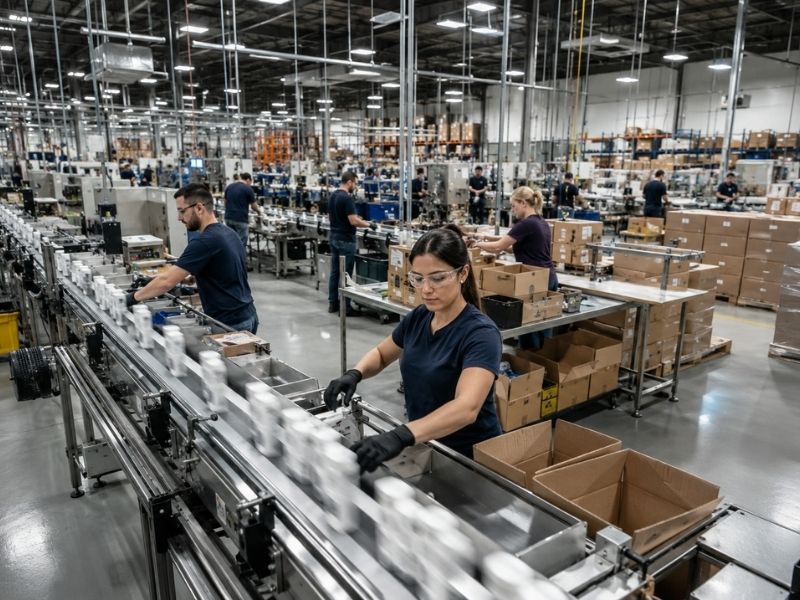
Large scale packaging should make your operation more efficient. Instead, it often makes it more complex.
As volume increases, so do moving parts. More SKUs. More coordination. More pressure on timelines. Without the right systems in place, growth introduces friction that slows everything down.
The goal is not just to scale large scale packaging. It is to do it without creating unnecessary complexity in your packaging operations.
Why Complexity Increases as You Scale
Scaling is not linear.
As production grows, packaging operations must manage:
- Higher output across multiple SKUs
- More frequent changeovers
- Increased coordination between teams
- Greater pressure on timelines and consistency
Without structure, these variables multiply quickly.
What once worked with a small team and simple workflows becomes harder to control at scale.
The Hidden Cost of Complexity
Complexity does not always show up as a clear problem.
It shows up as:
- Slower production speeds
- Increased coordination effort
- More frequent errors
- Difficulty adapting to change
Over time, complexity reduces efficiency and limits your ability to grow.
Where Complexity Comes From in Large Scale Packaging
1. Too Many Moving Parts
As operations expand, companies often add:
- More vendors
- More internal processes
- More layers of communication
While these additions may solve short-term challenges, they often create long-term inefficiencies.
2. Inconsistent Processes
When workflows vary across teams or SKUs, it becomes harder to maintain consistency.
Inconsistent processes lead to:
- Confusion during production
- Increased training requirements
- Greater risk of errors
Standardization becomes critical as operations scale.
3. Systems Not Designed for Growth
Many packaging operations are built for current needs, not future demand.
This leads to:
- Bottlenecks at key stages
- Limited flexibility to adjust production
- Increased reliance on manual coordination
Without scalable systems, complexity increases with every new requirement.
How to Scale Without Adding Complexity
Simplify the System
The first step is reducing unnecessary complexity.
Focus on:
- Consolidating processes where possible
- Reducing the number of handoffs between teams
- Streamlining workflows across production stages
Simpler systems are easier to scale.
Standardize Packaging Operations
Consistency improves efficiency.
Standardization allows you to:
- Train teams more effectively
- Reduce variability in output
- Improve coordination across departments
In large scale packaging, standardized processes create stability.
Design for Flexibility
Scalable systems are flexible.
They can:
- Adjust to changing demand
- Support multiple SKUs
- Handle both small and large production runs
Flexibility prevents the need for constant restructuring as your business grows.
Use Automation Strategically
Automation helps reduce complexity by:
- Minimizing manual processes
- Increasing production speed
- Improving consistency
In packaging operations, automation is often key to maintaining efficiency at scale.
Centralize Accountability
Clear ownership reduces confusion.
When responsibility is centralized:
- Decisions are made faster
- Issues are resolved more quickly
- Communication becomes more efficient
This improves overall control of the operation.
Leverage the Right Partners
External partners can help absorb complexity instead of adding to it.
Working with the right partner allows you to:
- Reduce internal coordination
- Access scalable systems
- Maintain flexibility without overbuilding infrastructure
In many cases, this is how companies scale efficiently without increasing internal burden.
What Scalable Packaging Operations Look Like
Operations that scale successfully share common characteristics:
- Clear and standardized processes
- Systems designed for both current and future demand
- Flexibility to handle variability
- Minimal unnecessary complexity
They are built intentionally, not adjusted reactively.
Choose a Leading Contract Manufacturer
Large scale packaging does not have to create complexity.
With the right systems, processes, and partners, your packaging operations can scale efficiently and support long-term growth.
If you are looking to simplify and scale, MaxUS Operations can help you build a system designed for performance and flexibility.