


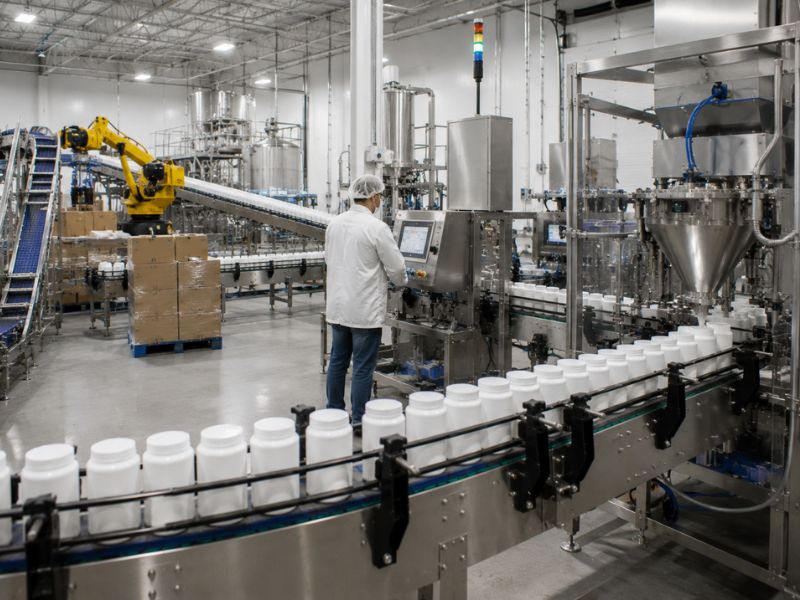
Every vendor added to a production chain brings its own lead time, its own point of failure, and its own coordination overhead. Single-source packaging consolidates filling, assembly, and often fulfillment under one partner, cutting out the handoffs that tend to be where delays actually happen — not inside any single vendor’s process, but in the gaps between them, where no one party is fully accountable for what falls through.
What Single-Source Packaging Actually Consolidates
- Filling and blending, so a formulation moves straight from mixing into containers
- Packaging and labeling, handled on the same schedule as production
- Sub-assembly services for kits or multi-component retail units
- Warehousing and outbound fulfillment once product is finished
The Hidden Cost of Multiple Vendors
Outsourced packaging split across several specialists often looks cheaper on paper, since each individual vendor might quote a lower per-unit rate than a full-service partner. What that simple comparison misses is the coordination cost: scheduling conflicts between vendors, shipping product between separate facilities, and the communication overhead of managing several relationships instead of one.
Sub-Assembly and Kitting Under One Partner
Sub-assembly services — combining multiple components into a finished retail unit — depend heavily on timing. When kitting happens under the same roof as the individual component filling, a late piece from one line doesn’t force an external vendor into a holding pattern waiting for delivery.
Where Warehousing and Fulfillment Fit In
Turnkey packaging solutions that extend into warehousing and fulfillment close the final gap between finished product and shipped order. A single vendor packaging arrangement that stops at the packaging line still leaves a brand managing a separate logistics relationship, which reintroduces some of the coordination overhead single-sourcing is meant to remove.
When Single Vendor Packaging Makes the Most Sense
Consolidation pays off most clearly for brands managing multiple SKUs, formats, or seasonal volume swings, where coordinating several specialist vendors would otherwise require dedicated internal staff just to manage the handoffs. A brand with one simple product and steady, predictable volume may see less benefit, since there’s less coordination complexity to remove in the first place.
What to Evaluate Before Consolidating
- Current vendor count across filling, packaging, warehousing, and fulfillment solutions
- How much internal time goes into coordinating handoffs between those vendors today
- Whether a single partner can genuinely match the quality of your current specialists in each stage
- What happens to existing vendor relationships and contracts during a transition
Making the Transition Without a Production Gap
Moving from several vendors to one rarely happens overnight, and a phased transition generally works better than switching everything at once. Brands often start by consolidating the two stages with the most coordination friction between them — filling and packaging, for instance — before adding warehousing and fulfillment once that initial handoff is running smoothly.
FAQs
Does single vendor packaging cost more than using specialists for each stage?
Not necessarily — per-unit pricing might look higher on a single quote, but the total cost often comes out lower once freight between facilities, scheduling delays, and coordination labor are factored in.
Can a single-source partner still offer specialized formats like sub-assembly services?
Many can, particularly partners with broad capability across filling, packaging, and retail assembly — it’s worth confirming which specific formats and services a given partner runs in-house versus outsources themselves.
What’s the biggest risk of consolidating too many vendors into one?
Depending too heavily on a single partner concentrates risk if that partner faces a disruption — worth weighing against the coordination benefits, particularly for a brand’s highest-volume or most time-sensitive products.
How do I know if my brand is ready for single-source packaging?
If you’re currently managing more than two or three separate vendors for filling, packaging, and fulfillment, and spending real time coordinating handoffs between them, that’s usually a sign consolidation is worth evaluating.
One Partner, Fewer Gaps
MaxUS runs filling, packaging, kitting, and fulfillment under one roof, so handoffs between vendors stop being a variable in your production timeline. Managing more vendors than you’d like right now? Tell us what your current setup looks like.