


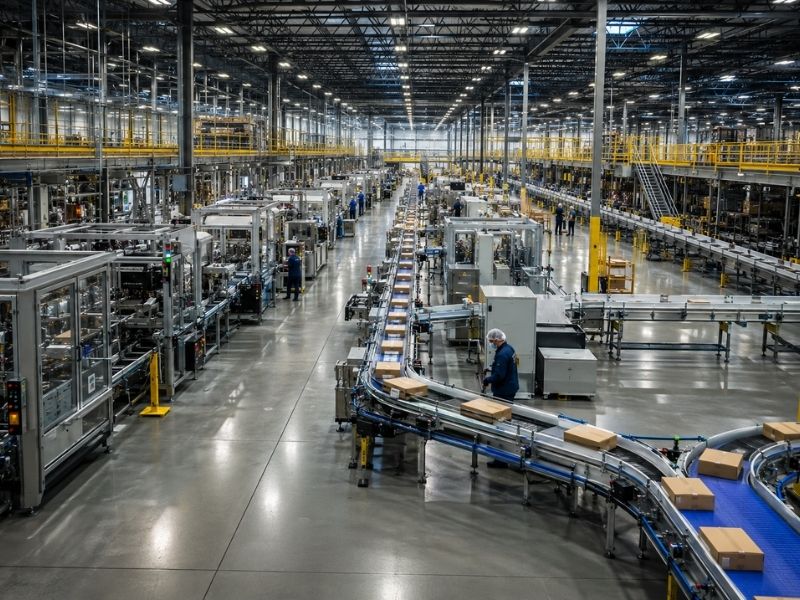
Packaging operations don’t fail because teams are unprepared. They fail because systems that worked at one level are pushed beyond what they were designed to handle.
Growth exposes everything. What once felt efficient becomes strained. What once worked smoothly begins to slow down. And in large scale packaging environments, those small cracks turn into operational bottlenecks quickly.
The goal isn’t just to grow. It’s to grow without breaking the systems that support you.
Why Growth Changes Everything
Scaling isn’t just about producing more. It changes how your entire operation functions.
As demand increases, packaging operations must handle:
- Higher production volume
- More SKUs and product variations
- Increased coordination across teams
- Tighter timelines and delivery expectations
Without systems built for scale, complexity increases faster than capacity.
Failure Point #1: Systems Designed for the Past
Many packaging operations are built around initial product launches or early growth stages.
These systems often:
- Rely on manual processes
- Lack flexibility for multiple SKUs
- Are optimized for lower volume
As production increases, these limitations become clear.
How to Fix It
- Redesign processes with scalability in mind
- Reduce reliance on manual coordination
- Implement systems that support higher volume and variability
Your systems should match where your business is going, not where it started.
Failure Point #2: Bottlenecks in Large Scale Packaging
Bottlenecks are one of the most common issues in large scale packaging.
They often occur when:
- One stage of production moves slower than others
- Equipment cannot keep up with demand
- Changeovers between SKUs take too long
Even small inefficiencies create delays when volume increases.
How to Fix It
- Identify bottlenecks early through process analysis
- Optimize workflows across all stages of production
- Use automation to improve consistency and speed
Efficiency at scale requires alignment across the entire system.
Failure Point #3: Lack of Coordination Across Teams
As operations grow, coordination becomes more complex.
Common challenges include:
- Misaligned production schedules
- Communication gaps between teams
- Unclear ownership of tasks
These issues slow down execution and increase the risk of errors.
How to Fix It
- Centralize ownership of packaging operations
- Standardize communication processes
- Reduce the number of handoffs between teams or vendors
Clear alignment is critical for maintaining speed and consistency.
Failure Point #4: Labor Strain and Resource Gaps
Growth often puts pressure on staffing.
Signs include:
- Increased overtime
- Difficulty maintaining consistent output
- Training gaps as teams expand quickly
Labor challenges can reduce efficiency and increase the likelihood of mistakes.
How to Fix It
- Plan for scalable staffing models
- Cross-train employees to improve flexibility
- Reduce manual processes through automation
Labor should support growth, not limit it.
Failure Point #5: Reactive Decision-Making
One of the clearest signs of failing packaging operations is constant reactivity.
Teams may find themselves:
- Adjusting schedules daily
- Managing delays instead of preventing them
- Prioritizing short-term fixes over long-term improvements
This approach creates instability.
How to Fix It
- Shift from reactive to proactive planning
- Build systems that anticipate demand fluctuations
- Use data to guide decision-making
Sustainable growth requires control, not constant adjustment.
Failure Point #6: Packaging Becomes the Bottleneck
In many operations, packaging becomes the limiting factor.
This happens when:
- Production outpaces packaging capacity
- Packaging processes are less efficient than upstream operations
- Systems are not designed to handle increased volume
When packaging slows down, the entire operation is impacted.
How to Fix It
- Align packaging capacity with production output
- Invest in scalable packaging systems
- Consider external partners to support overflow or growth
Packaging should enable growth, not restrict it.
How to Build Packaging Operations That Scale
Fixing these issues requires a shift in approach.
Instead of reacting to growth, companies need to design packaging operations that are built for it.
This includes:
- Simplifying processes wherever possible
- Reducing complexity across systems
- Centralizing accountability
- Leveraging partners who can absorb variability
In large scale packaging, success comes from preparation, not reaction.
Your Trusted Packaging Partner
Packaging operations fail during rapid growth when systems are not designed to scale.
If your operation is starting to feel strained, MaxUS Operations can help you build flexible, scalable systems that keep your production moving forward without disruption.
FAQ Section
Why do packaging operations fail during growth?
They fail because systems that worked at smaller volumes are not designed to handle increased complexity and demand.
What are the biggest challenges in large scale packaging?
Common challenges include bottlenecks, coordination issues, labor constraints, and inefficiencies in production processes.
How can companies improve packaging operations at scale?
By optimizing workflows, implementing automation, and designing systems that support growth.
Can outsourcing help improve packaging operations?
Yes. External partners can provide additional capacity and scalable systems to support growth.