


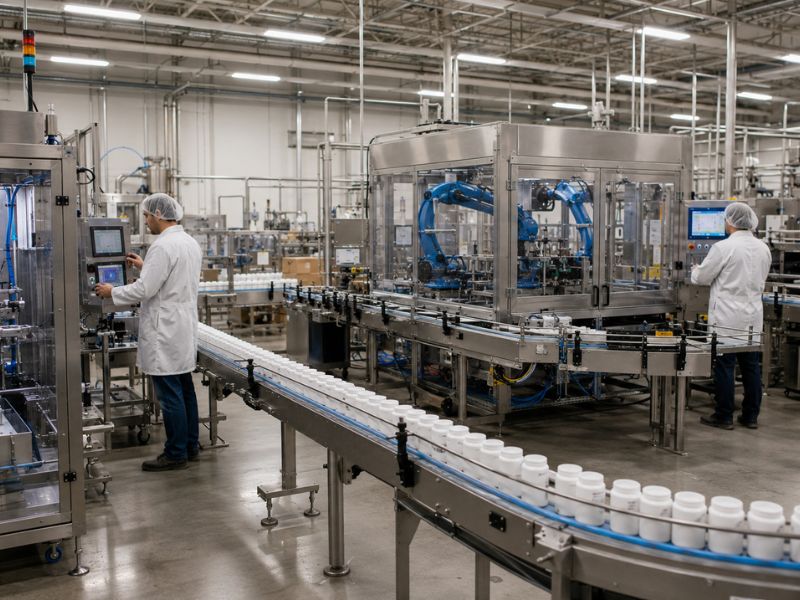
Co-manufacturing and co-packaging are used interchangeably in a lot of CPG conversations, but they solve different problems. The short version: co-manufacturing covers making the product itself, while co-packaging covers filling and packaging a product that already exists. Knowing which one your brand actually needs — before you start vetting partners — saves weeks of misaligned RFQs.
For any cpg manufacturer sorting out cpg packaging needs, that distinction shapes everything from the questions you ask a potential partner to the capabilities you should expect them to have.
What Is Co-Manufacturing?
A co-manufacturer — sometimes written as “co manufacturer” without the hyphen — produces the product based on your formula or specification. That means they’re involved in blending, mixing, or formulating, not just handling a finished product. If your brand doesn’t have its own production facility, or needs help scaling a formula that was developed at a much smaller batch size, you’re looking for a cpg contract manufacturing partner, not just a filler.
- Formulates or produces the product to your spec
- Often involved in ingredient sourcing or batch consistency
- A closer fit for brands without an existing production process
What Is Co-Packaging?
A co-packager takes a product you’ve already made or sourced and handles the filling, packaging, and often the labeling and fulfillment around it. You’re not asking them to produce the product — you’re asking them to package it consistently, at scale, in the format your retail or e-commerce channel needs.
- Fills and packages an existing formulation
- Focused on format, throughput, and packaging consistency
- A closer fit for brands that already have a finished product and need capacity
[Suggested image: Split visual showing a formulation/blending tank next to a packaging line — alt text: “co-manufacturing vs co-packaging process comparison”]
Co-Manufacturing vs Co-Packaging: The Key Differences
Side by side, the distinction comes down to where the partner enters your process:
- Co-manufacturing = product creation + production. Co-packaging = product handling + packaging.
- Co-manufacturing typically requires formula or recipe sharing. Co-packaging typically doesn’t.
- Co-manufacturing is closer to what people mean by a toll manufacturer or contract manufacturer vs toll manufacturer comparisons — producing to spec under contract. Co-packaging is closer to a pure fulfillment-adjacent service.
- A brand can need one, the other, or both, depending on how much of the product is already “done” before it reaches the packaging line.
Which One Does Your Brand Need?
Ask a simple question first: does the product already exist in its final form, or does it still need to be made? If it needs to be made, you need cpg contract manufacturing capability — a true co-manufacturer. If it’s already formulated and you just need it filled, sealed, labeled, and ready for retail, co-packaging is the right search term and the right scope of work.
Why Some Brands Need Both
Plenty of CPG brands don’t fit neatly into one category. A brand might have its formula locked but still need blending support at scale, then move directly into packaging without a hand-off to a second vendor. That’s where a single-source partner matters: instead of managing a co-manufacturer and a co-packager separately, one provider handles
filling, blending, and mixing through contract filling and packaging under one roof, which removes the coordination gap between production and packaging altogether.
FAQs
Is a toll manufacturer the same as a co-manufacturer?
They’re closely related terms often used interchangeably. Both describe a partner producing a product to your specification under contract, which puts them on the co-manufacturing side of this comparison rather than co-packaging.
Can one partner handle both co-manufacturing and co-packaging?
Yes, and for brands managing both blending/production and packaging, working with a single provider for both stages reduces the hand-offs, timelines, and communication gaps that come with using two separate vendors.
Does co-packaging include private labeling?
It can. Co-packaging scope varies by provider, so it’s worth confirming during vetting whether labeling, kitting, or retail-ready assembly are included or handled as separate services.
How do I know if my product needs co-manufacturing instead of just co-packaging?
If your product isn’t fully formulated yet, or you need help scaling a recipe past small-batch production, that’s a co-manufacturing need. If the product is finished and the gap is purely in filling, sealing, and packaging it, co-packaging is the right scope.
One Partner for Both Sides of the Process
MaxUS Operations supports CPG brands across both sides of this comparison — from filling, blending, and mixing to full contract packaging capabilities. If you’re not sure which side of the co-manufacturing vs co-packaging line your brand falls on, contact our team and we’ll help you scope it correctly before you start requesting quotes.
Related reading: for the broader distinction between contract packaging and contract manufacturing as service categories, see our related post: The Difference Between Contract Packaging and Contract Manufacturing.