

Launching a new product usually means one of two paths: buy the equipment to fill it yourself, or find contract fillers who already have the lines running. The first path ties up capital in machinery you may only need for one launch. The second gets product moving without the up-front investment — which is why most brands launching liquids, powders, or solids for the first time start with contract filling services instead of a capital purchase.
The Capital Problem With Launching In-House
Filling equipment is expensive, product-specific, and slow to justify before you know how a launch will actually perform. A brand weighing in-house filling for a new SKU is often looking at:
- Equipment costs that assume a sales volume you haven’t proven yet
- Additional floor space, utilities, and facility requirements
- New hires or retrained staff to operate a line you didn’t have before
- Lead time to install and validate equipment before the first unit ships
None of that is a reason to avoid launching — it’s a reason to separate the decision to launch from the decision to own equipment.
What Contract Fillers Bring to the Table
Working with contract fillers means the equipment, labor, and floor space already exist. You’re launching into capacity that’s already running, rather than building it from scratch.
- Filling lines already validated for liquids, powders, and solid products
- Trained labor and quality checks already built into the process
- Flexibility to launch at a smaller volume without a large equipment commitment behind it
- The option to scale up production without renegotiating a facility lease or capital budget
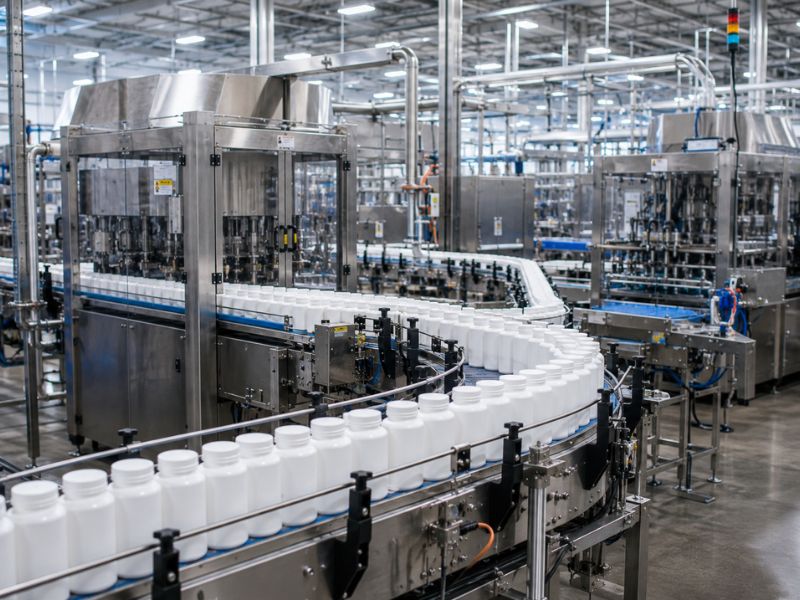
[Suggested image: Contract filler operating a liquid fill line with bottles moving down a conveyor — alt text: “contract fillers liquid filling production line”]
Liquids, Powders, and Solids: Why Format Matters
Not every contract filler handles every product format the same way, which is worth confirming before you commit to a launch timeline.
- Liquid fill contract packaging requires viscosity-appropriate equipment and container compatibility — a partner experienced with contract liquid filling companies’ typical range of products will flag issues before they show up on the line.
- Bottle filling contract packaging in particular depends on matching cap torque, fill level accuracy, and line speed to the container you’ve chosen.
- Powder and granular filling depends on dust control, flow consistency, and dosing accuracy.
- Solid product filling often ties more closely to packaging format — pouch, bottle, or tub — than to the fill process itself.
MaxUS supports filling across all three, tied directly into filling, blending, and mixing and into rigid or flexible packaging formats depending on what the product needs.
What You Still Own (and What You Don’t Have To)
Using contract fillers doesn’t mean giving up control of the product — it means giving up ownership of the equipment and labor required to fill it.
- You still own the formula, brand, and go-to-market decisions
- You still set the quality standard the partner is expected to hit
- You don’t own the filling equipment, the maintenance schedule, or the hiring
- You don’t carry the fixed cost of a line built around a single, unproven launch
FAQs
Do contract fillers work with small-batch or trial launches?
Many do, though minimums vary by partner and product format. It’s a reasonable question to ask upfront, especially for a first launch where volume isn’t proven yet.
Can contract fillers handle both liquid and powder products for the same brand?
Some can, depending on their equipment range — which matters if your brand plans to launch multiple formats over time and would rather manage one relationship than several.
What happens to my formulation when I use a contract filler?
A contract filler follows your formula and fills to your specification; they’re not typically involved in developing or altering it, which stays under your brand’s control throughout.
How fast can a contract filler get a new product running?
Timelines depend on format complexity and current production scheduling, but starting with existing lines is generally faster than installing and validating new equipment from scratch.
Launch Without Building the Line Yourself
MaxUS Operations provides contract filling and packaging for liquids, powders, and solid products, backed by filling, blending, and mixing capability under one roof. If you’re weighing a launch against a new equipment purchase, reach out and we’ll help you figure out what capacity actually fits.
Related reading: for a closer look at how the filling process works step by step, see Inside the Contract Filling Process, and for how outsourced filling streamlines production more broadly, see Contract Filling Services Explained.